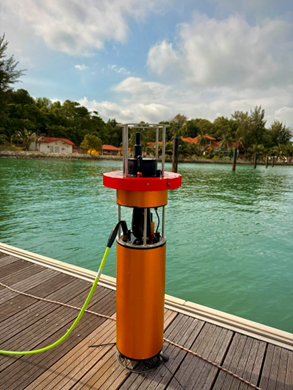


The Acoustic Research Laboratory conducts basic and applied research with the aim of becoming the pre-eminent marine acoustic research laboratory in Southeast Asia. From every aspect of marine operations acoustics is the natural tool for use under water as sound can travel over several kilometers whereas other forms of energy are useful only at very short ranges. For man to operate efficiently underwater, we need to develop acoustic techniques to augment the conventional ways in which we see and study the marine environment. As we see the future of marine sensing in networked autonomous assets, we also conduct research in the areas of networked underwater autonomous assets.

Our research programmes are oriented towards providing an effective marine research capability for Singapore to fulfill its needs with respect to managing its marine resources. We also support affiliated marine research laboratories in their work where acoustic tools and research inputs are required.

To accomplish our exciting research goals, we are always keen to bring on-board enthusiastic electronic engineers, scientists and acousticians looking for a challenge. If you think you want to join us, check out available research opportunities.

  
Research Areas 
   
Underwater Acoustic Communications

Acoustics provides the most obvious choice of channel to enable underwater communications, a key technology in several underwater applications. Although acoustics has been used effectively for point-to-point communications in vertical deep water channels, acoustics has had limited success in warm shallow water. Rapid time-varying multi-path propagation and non-Gaussian noise are two of the major factors that limit acoustic communications in warm shallow water. Typical networking protocols designed for electromagnetic wireless communications do not work well for underwater acoustic networks due to vast differences in latency as well as packet loss. In order to effectively establish communication networks in warm shallow waters, we explore several technologies for point-to-point communications and develop & test promising networking protocols for underwater use.


Ambient Noise Studies

An understanding of the ambient noise environment in shallow waters is essential for marine scientists and navies of today. The characteristics of shallow water ambient noise often influence the performance of underwater acoustic communications and remote detection systems. The objective of this research is to provide a better understanding and complete knowledge of ambient noise characteristics in shallow water environments.


Cooperative Autonomous Underwater Vehicles

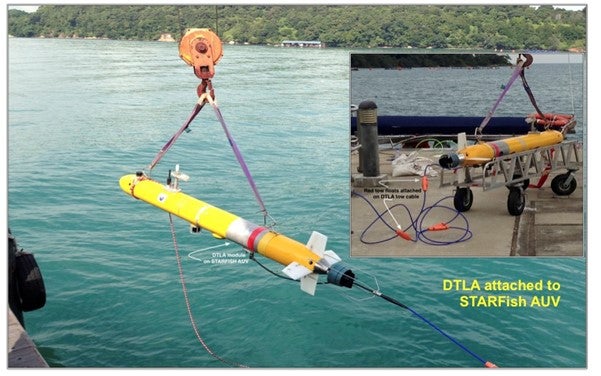
Autonomous Underwater Vehicles (AUVs) provide an effective way to survey and monitor our oceans. As the capabilities of AUVs increase, they become large, heavy, complex and expensive. Our research is focused on developing small, light and low-cost AUVs that can cooperate and perform complex tasks as a heterogeneous team. The research in this area spans many disciplines.


Biosonar

Dolphins are able to investigate their environment through echolocation in conditions where vision is limited (eg turbid water or at night). Experiments conducted at the Kewalo Basin Marine Mammal Laboratory in Hawaii and Ocean Park in Hong Kong have shown that object shape can directly perceived through echolocation in a holistic manner, similar to the direct shape perception of shape through vision. No man-made sonar of comparable bandwidth can perform this feat. This project is investigating the dolphin's ability to recognize shape through echolocation.


Ambient Noise Imaging

Ambient Noise Imaging (ANI) has been an area of interest in the ARL for many years now. The principle underlying this phenomenon makes use of the ensonification provided by the ambient noise field to create pictorial images of underwater objects. Ambient noise imaging is well suited for the warm shallow waters of SE Asia, where snapping shrimp serve as an excellent source of illumination. The ARL has developed a class of new algorithms including the one based on the Acoustic Daylight (AD) idea to form images out of the ambient noise data. ARL has also built a system called Remotely Operated Mobile Ambient Noise Imaging System (ROMANIS), an ambient noise imaging underwater acoustic camera. The system underwent its first underwater functional test recently.


Signal Processing

At the ARL, signal processing is an integral part of what we do. Signals recorded underwater using hydrophones always need some processing. Apart from fairly standard signal processing such as filtering, and beamforming data collected from a hydrophone array, we have developed several of our own techniques to process signals recorded underwater in the areas of denoising, classification and feature extraction. Due to the non-Gaussian nature of high frequency ambient noise in local waters, some of our signal processing research efforts are directed towards the development of optimal or near-optimal processing of signals in impulsive noise.


Humpback Whale Song Characteristics

This humpback whale project investigates the vocalizations of humpback whales (Megaptera novaeangliae) that come to the wintering grounds around the four-island region of Maui, Molokai, Lanai and Kaho'olawe each year between December and April. Humpback whales produce "songs" that are broadband transient signals. A typical song last about 10-12 minutes and consists of 4-6 themes, these themes consisting of 2-4 repeated phrases containing 4-6 units that last about 1-2 seconds. The function of humpback whale song remains unclear although several explanations have been offered over the years. Very little is really understood about sound productions mechanisms or propagation of song today.