


Real-time, in-situ observations are essential to “ground truth”, correct for model biases, fill gaps, and provide accurate inputs for forecasting models in fast-changing marine environments. Manned platform-based observations are expensive and challenging, especially in monitoring remote areas and under hazardous environments. Data are often required to be collected over an extended period which adds to the operational challenges.
Autonomous profiling devices or drifters have been employed as an alternative to traditional ocean monitoring using ships and moored buoys. For example, the Argo program employs over 4,000 floats annually for ocean observation and they measure temperature, pressure, and salinity as they drift at depth, contributing data to climate change studies. The program also employs separate biogeochemical floats that measure chlorophyll, nitrate, oxygen, pH, and suspended particles in the ocean water column. These floats are designed to operate in deeper waters and transmit data only once every 10 days. They are expensive when sourced in small quantities and have limited capabilities per float.
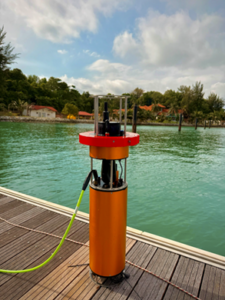
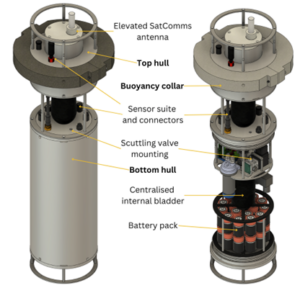
Availability of low-cost sensors and electronic modules have made it possible to drive down the cost of floats. ARL has built such a low-cost float (under S$15k) with enhanced capabilities for use in oceanographic research. The system has been designed for shallow water applications and provides data at the end of every profiling cycle via a satellite link.
Features:
• Sensors: Temperature, pressure and conductivity, echo sounder (to measure bathymetry) and a hydrophone (to measure the ambient noise)
• Depth: Up to 200 m
• Endurance: 100 profiling cycles
• Pre-processed data are transmitted via a satellite link and presented to the end user through a graphical interface
• Expendable at the end of its life, if desired to reduce cost of recovery
• Programmable mission
Learn more about the system here:
V. Pallayil, C. C. Ng, L. T. Khoon and M. Chitre, “A Low-cost, Expendable Shallow Water Profiling Float with Improved Capabilities,” in 2025 IEEE Underwater Technology (UT), Taipei, Taiwan, 2-5 March 2025, pp. 1-5. [ DOI ]