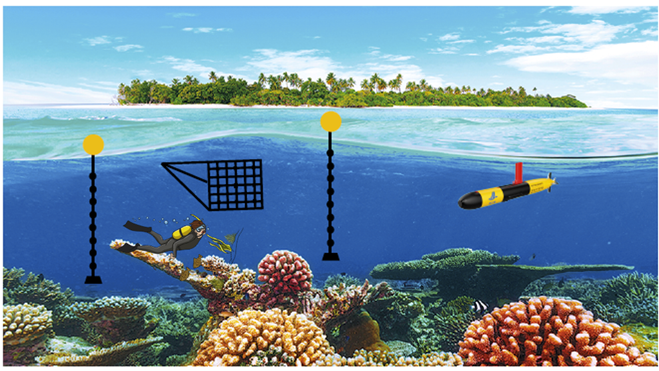



The ocean is filled with the distinctive crackling sounds of snapping shrimp, one of the most dominant noise sources in Singapore’s coastal waters. These highly social creatures exhibit fascinating collective behaviors, including the ability to respond as a group to important stimuli such as the presence of intruders in their territory. When disturbed, many shrimp in a colony will suddenly begin snapping in unison, producing a distinctive crackling noise that can last for several seconds or more. This coordinated response presents an intriguing opportunity for underwater surveillance applications.
The MCMOUS project explores whether changes in the acoustic behavior of snapping shrimp can be detected and used as an indicator of underwater intrusions. Our experiments have successfully demonstrated that several acoustic features, including the number of snaps, the timing between snaps, and the variation in these intervals, can serve as reliable indicators when an intruder such as a diver or autonomous underwater vehicle is present. Analysis of our recordings shows that snap rates increase noticeably during intrusion events, and most of the snapping activity originates from the reef itself. Early machine learning models trained on this data show promising results for automated intruder detection.
Building on these initial findings, the next phase of research will focus on understanding exactly how snapping shrimp detect and respond to different types of underwater sounds. Recent studies have shown that these creatures can detect acoustic signals in the frequency range of 50 to 1500 Hz, which overlaps with the sounds produced by underwater vehicles and human activity. Future experiments may help us understand which specific acoustic characteristics trigger the shrimp’s coordinated response, potentially enabling a novel biological approach to monitoring underwater environments.